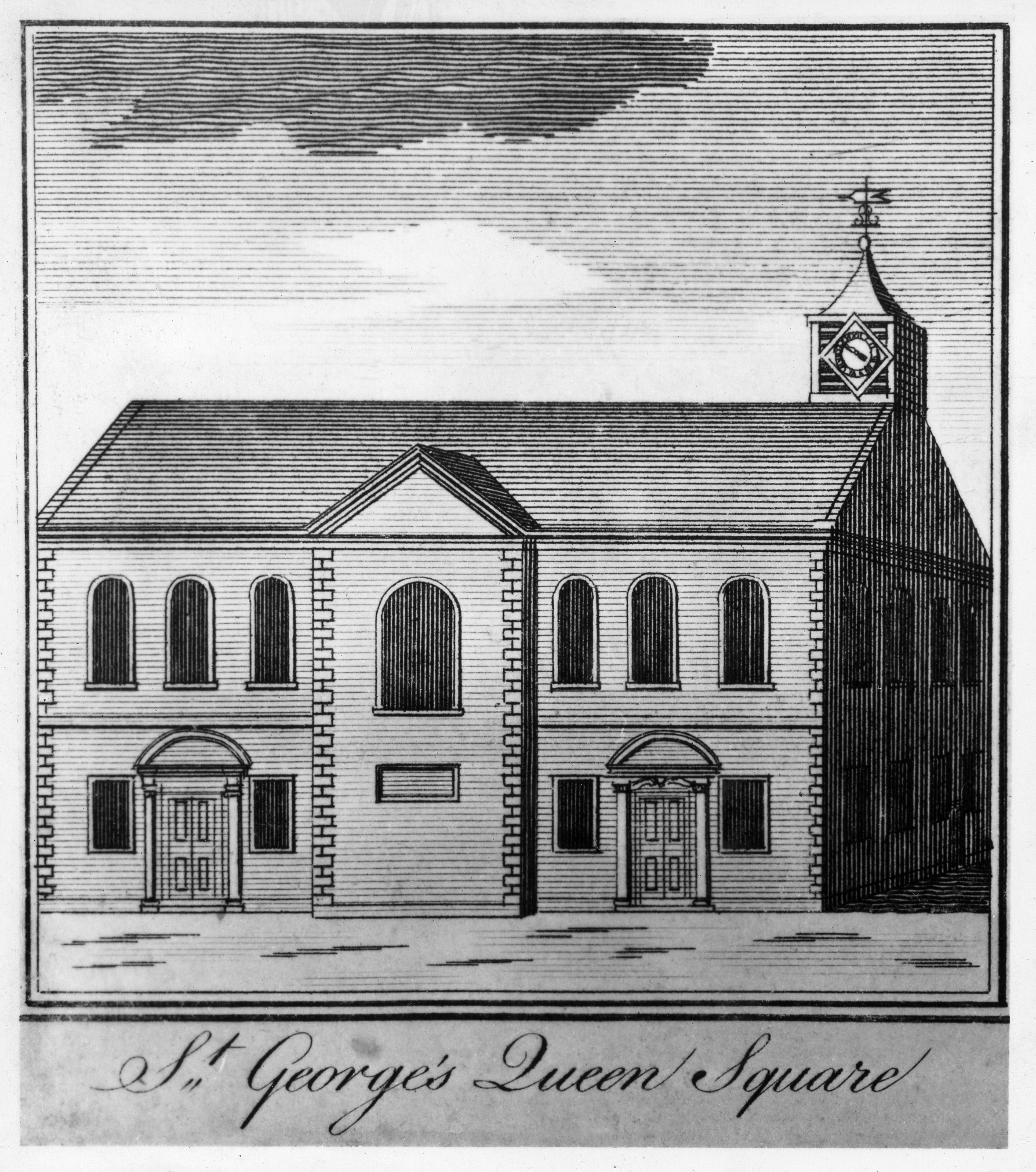
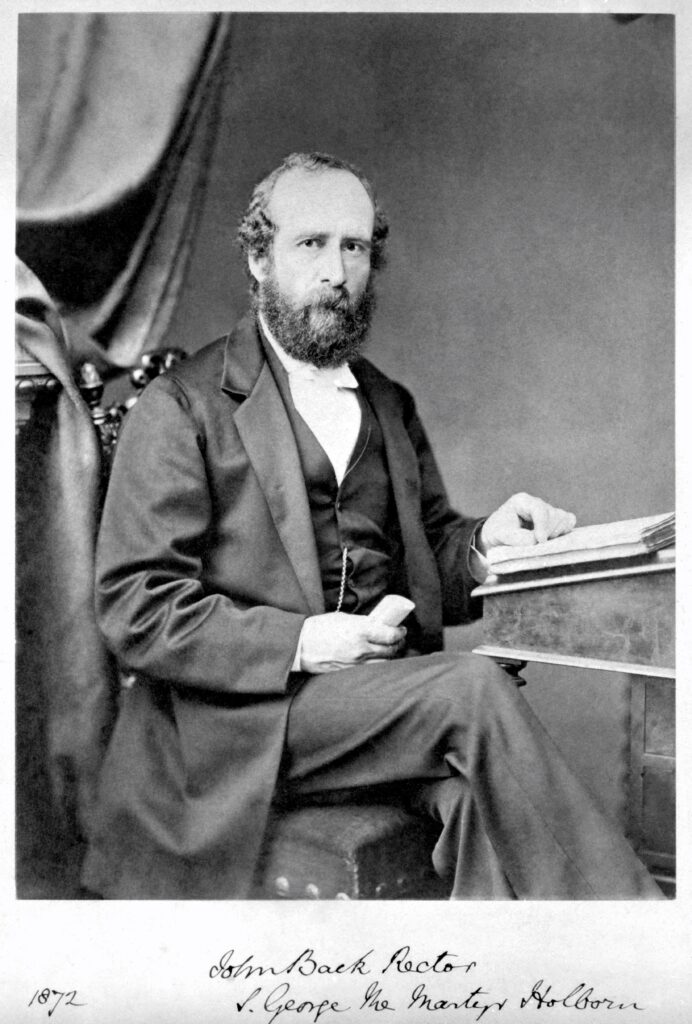
In 1867-68 Reverend John Back employed the English Gothic Revival architect S.S. Teulon to remodel the building. Teulon lived for some time in the parish and his children were baptised in the church. He turned the church to face south instead of east, removing the south and east galleries to create a chancel for a choir and a huge new window, with stone and mosaic reredos depicting Abraham, Moses, Solomon, St Peter, St John and St Paul, along with a new pulpit. He also remodelled the clock and its tower. Done during a period of intense social reform in the parish, Teulon’s ‘muscular gothic’ style probably aimed to connect a neo-classical building, whose style now connoted impersonality and dehumanising regularity, back to the more person-centred, craft-centred and socially-equal world of the early Middle Ages. This, at any rate, was the architectural thesis of John Ruskin, who taught at the Working Men’s College, and of William Morris, who had a house and shop featuring fairly-waged, artisanal homewares at 26 Queen Square.
WW2 left the church in a state of disrepair, with broken windows, rotten timbers and an unsafe roof, and the building was condemned as unfit by the Diocese. A campaign in time for the 250th Anniversary of the parish in 1956 raised money from St George’s congregations around the world to make the building habitable and safe again. The stained-glass window of St George, the Roman soldier martyred for his faith in 303, dates from this renovation, signifying courage, endurance and peace in the midst of conflict.
Medicine
The best-known rector of St George the Martyr was the Revd William Stukeley who led the church from 1747 until his death in 1765. He had a wide-ranging and enquiring mind, and had been a medical practitioner before taking Holy Orders at the age of 42. Turning his expertise in anatomy towards the unpeeling of the layers of history in archaeological sites, he became fascinated by the stones of Stonehenge and Avebury, believing them to be the remnants of pre-Christian Druidic religion, an idea that also inspired the poet William Blake. Stukeley’s careful maps of Stonehenge, as detailed in the book he wrote in 1740, Stonehenge: A Temple Restor’d to the British Druids, are still useful to archaeologists today because they record the site before it was disturbed by other diggings.
Florence Craven Lees pioneered district nursing in London – nursing care provided at home or in convalescent homes. She was friends with Florence Nightingale, served in the Franco-Prussian War and eventually wrote Guide to District Nurses and Home Nursing (1889), which became the central manual for all London nurses. She was awarded numerous medals for her work and became famous before marrying Rev. Dacre Craven, rector of St. George, in 1879.
The John Back Ward in the Neurology Hospital is named in honour of this former rector who was a generous supporter of the hospital.
Literature and Arts
William Copwer (1731-1800), the poet and hymnwriter, worshipped at St. George’s in his younger years as he trained for the bar.
The multi-talented William Brockedon (1787-1854), artist, travel writer and inventor, was a parishioner for over thirty years and his memorial stone is on the inner north wall of the church. Born into a lower-middle class watchmaking family in Totnes, Brockedon’s talent and energy were spotted by the local rector and he was given an artist’s training at the Royal Academy. Beginning his career as painter of mythological subjects and society portraits, his quest to find the original route Hannibal had taken across the Alps led him to branch out into illustrated travel books for Alpine adventurers, as war receded and tourism became more possible. Often made uncomfortable by mountain weather, he invested in Mackintosh’s new water-proofing system, and used the rubber technology to invent more air-tight seals for chemical flasks. His dissatisfaction with the quality of pencils available for his sketches led him to invent a new kind of artificial compressed lead – graphite, still in use. Unexpectedly, this also led the first accurate pill-compressing machine which required no extra binders or fillers to interfere with the medicine’s effect, a discovery for which he is remembered in the Science Museum today. He is one of the very people to have been a member simultaneously of the Royal Academy, the Royal Geographical Society and the Royal Society, and his portraits of mid-Victorian artists, explorers, writers and scientists can still be seen at the National Portrait Gallery.
John Leech, caricaturist for Punch, lived in Great Ormond Street and attended the church. He illustrated the first edition of Dickens’ A Christmas Carol.
Four months after they met, Sylvia Plath & Ted Hughes, two of the most acclaimed poets of the 20th century, married on 16th June 1956 in the church. Ted Hughes immortalised the day in ‘A pink wool knitted dress’. The couple lived nearby in Rugby Street.
Social Reform
St George’s is sometimes called “The Sweeps Church”. This name derives from the benefaction of Captain James South who in 1834 bequeathed £1000 to the rector and the church wardens to apply the interest in providing “a Christmas dinner for one hundred poor boys” apprenticed to chimney-sweeps in the Cities of London and Westminster. Each Christmas the sweep’s boys came to the church and after the service had their dinner. The terms of the will provided that each should receive half a pound of roast or boiled beef, half a loaf of bread, half a pound of potatoes, half a pint of ale or porter, half a pound of plum pudding and a new shilling.
In 1854 the Working Men’s College was founded in Great Ormond Street, The Revd F.D. Maurice was one of the founders of the movement: an early Christian socialist and brilliant scholar he had been professor of theology at King’s College, London, until being dismissed for holding heterodox views on the afterlife. He lived at number 24, Queen Square. He is recognised by many as a pioneer of the liberal tradition of Anglicanism. In the Episcopal Church of the United States of America his life is commemorated on 1 April.
St George the Martyr School
There was a firm intention from the first that the church would involve itself in the education of children. This work stated in the church’s vestry around 1709. By 1839 the girls were still in a room over the vestry, but the boys had moved meanwhile to Devonshire Street where there was a schoolhouse. At this time there was a total of 140 pupils, compared with 90 in 1735. In 1854 the buildings in Devonshire Street (now Boswell Street) were replaced by the new buildings for girls and infants in Old
Gloucester Street. There was a boys’ school in Theobalds Road which continued on at that site until the 1870s. In the 1970’s the church school moved from its old buildings near the church to take up residence in new buildings in John’s Mews.
Project 300
Our Project 300 – Securing the Legacy project will enable us to unearth more stories of the history of the church and the people associated with it and Queen Square and we look forward to developing these pages to share more of these stories with you. We will also be developing a range of ways to be able to tell these stories in the church itself.